


Elbow pain is a common upper-limb problem that can interfere with everyday activities such as lifting, gripping, typing, carrying bags, opening containers or performing repetitive work. Some people develop pain gradually after repeated hand and wrist activities, while others experience symptoms after sports, heavy lifting, a fall or another injury.
The elbow is more than a simple bending joint. It forms an important mechanical connection between the shoulder, forearm, wrist and hand. Pain or weakness around the elbow can therefore affect grip strength, arm movement and the ability to perform work, household activities or sports comfortably.
Elbow pain does not always come from the same structure. Tendons, muscles, ligaments, joints, bursae and nerves can all produce different patterns of pain. Identifying the likely source of symptoms is therefore important before starting rehabilitation.
At Asia Digital Physiotherapy & Orthopedic Rehabilitation Center (ADPORC), elbow pain rehabilitation is planned according to the patient's clinical assessment, functional limitations and underlying condition. Treatment may involve activity and load modification, therapeutic exercise, mobility training, strengthening, manual therapy, nerve-related rehabilitation when indicated and other physiotherapy interventions according to clinical need.
Understanding Elbow Pain: A Structural Perspective
Elbow pain refers to discomfort arising from the elbow joint or the tissues surrounding it. Pain may be felt on the outer side, inner side, front or back of the elbow. In some conditions, symptoms may also extend into the forearm, wrist, hand or fingers.
Depending on the underlying problem, elbow symptoms may include pain, tenderness, stiffness, swelling, weakness, reduced grip strength, burning, tingling or numbness.
Pain around the elbow may originate from:
- Muscles and tendons
- Ligaments and joint capsule
- Bones and joint surfaces
- Bursae and surrounding soft tissues
- Peripheral nerves
- Less commonly, referred pain from another region
Because several conditions can produce similar symptoms, the location of pain alone cannot confirm a diagnosis. However, the pain pattern can provide useful clues about which structures may be involved.
Common Locations of Elbow Pain and What They May Mean
The exact location of elbow pain can help narrow down the possible causes.
1. Outer Elbow Pain
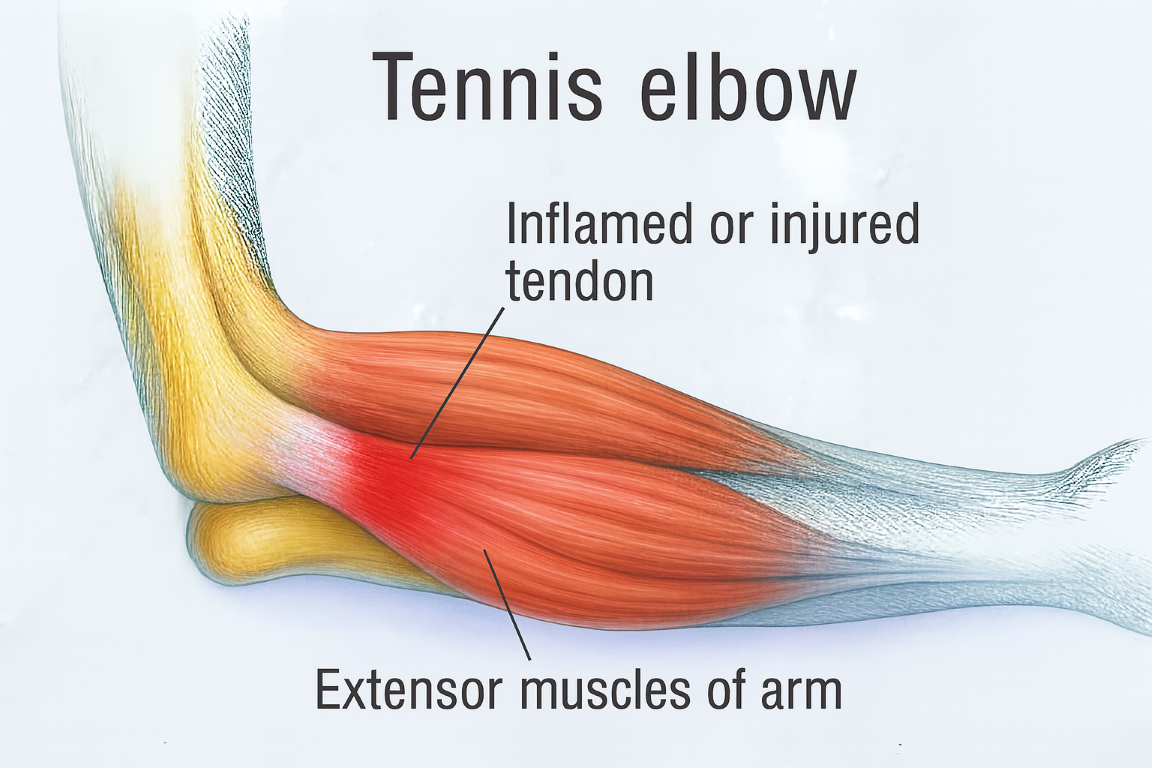
Pain around the lateral or outer side of the elbow is commonly associated with Tennis Elbow, also called lateral elbow tendinopathy or lateral epicondylitis.
Symptoms often increase during gripping, lifting a kettle or bag, using tools, shaking hands or repeatedly extending the wrist.
Outer elbow pain may also occasionally be associated with other conditions such as radial nerve irritation, ligament injury or joint pathology.
2. Inner Elbow Pain
Pain around the medial or inner side of the elbow is commonly associated with Golfer's Elbow, where the flexor-pronator tendon region becomes painful with repeated loading.
Inner elbow symptoms can also occur with ulnar nerve irritation or ligament-related problems.
3. Back of the Elbow Pain
Pain or swelling over the point of the elbow may occur with olecranon bursitis, particularly when the elbow is repeatedly placed against a hard surface.
Triceps tendon problems may also cause posterior elbow pain, particularly during pushing or resisted elbow extension.
4. Front of the Elbow Pain
Pain at the front of the elbow may involve structures such as the distal biceps tendon, particularly when symptoms increase during lifting, elbow flexion or forearm rotation.
A sudden painful injury with bruising or visible change in the biceps contour requires medical assessment.
5. Elbow Pain With Tingling or Numbness
Pain accompanied by tingling or numbness, particularly toward the ring and little fingers, may suggest involvement of the ulnar nerve, commonly seen in Cubital Tunnel Syndrome.
Nerve-related symptoms should be differentiated from tendon or joint-related elbow pain.
6. Elbow Stiffness With Aching Pain
Persistent stiffness, loss of range of motion and deeper joint pain may occur after previous injury, prolonged immobilization, osteoarthritis or other joint conditions.
Common Causes of Elbow Pain
Elbow pain may originate from tendons, nerves, bursae, ligaments or the joint itself. The conditions below are some of the common causes patients may encounter.
1. Tennis Elbow
Tennis Elbow, also known as lateral epicondylitis or lateral elbow tendinopathy, is a common cause of pain around the outer elbow.
It is associated with excessive or repeated loading of the wrist extensor tendon complex. Activities involving gripping, lifting, tool use, racket sports or repetitive hand movements may aggravate symptoms.
Typical symptoms include tenderness around the outer elbow, pain during gripping and reduced grip strength.
Related guide: Tennis Elbow (Lateral Epicondylitis): Causes, Symptoms & Physiotherapy Treatment
2. Golfer's Elbow
Golfer's Elbow, or medial epicondylitis/medial elbow tendinopathy, produces pain around the inner part of the elbow.
It involves the tendon region where the wrist flexor and pronator muscles attach near the medial epicondyle. Repetitive gripping, wrist flexion, throwing, manual work and some sporting activities may provoke symptoms.
Patients commonly notice inner elbow tenderness, pain when gripping and discomfort during resisted wrist movements.
Related guide: Golfer's Elbow (Medial Epicondylitis): Causes, Symptoms & Physiotherapy Treatment
3. Cubital Tunnel Syndrome
Cubital Tunnel Syndrome occurs when the ulnar nerve becomes irritated or compressed as it passes around the inner side of the elbow.
Unlike typical tendon pain, nerve involvement may produce tingling, numbness or altered sensation extending toward the ring and little fingers. Some patients may also experience hand weakness or reduced dexterity.
Symptoms may increase when the elbow remains bent for prolonged periods or when repeated pressure is applied around the inner elbow.
4. Olecranon Bursitis
The olecranon bursa is a small fluid-filled structure located over the point of the elbow. When it becomes irritated, the back of the elbow may become visibly swollen and tender.
Repeated leaning on the elbow, direct trauma and some inflammatory conditions can contribute to bursitis.
A hot, red, rapidly swollen elbow, particularly when accompanied by fever or illness, requires medical assessment because infection must be excluded.
5. Distal Biceps Tendon Problems
The distal biceps tendon attaches near the front of the elbow and contributes to elbow flexion and forearm supination.
Gradual tendon overload can produce pain during lifting or repetitive pulling activities. A sudden forceful injury may also cause a partial or complete distal biceps tear.
Sudden pain, bruising, marked weakness or visible deformity after an injury should be medically assessed promptly.
6. Triceps Tendinopathy
The triceps tendon attaches at the back of the elbow. Repetitive pushing, weight training or excessive loading may irritate the tendon and cause posterior elbow pain.
Symptoms may be aggravated by pushing movements, resisted elbow extension or exercises such as dips and presses.
7. Elbow Ligament Injury and Instability
The elbow is supported by several ligaments that help maintain joint stability.
Falls, sporting injuries, throwing activities or other sudden forces can injure these structures. Depending on severity, symptoms may include pain, swelling, instability, reduced movement or difficulty applying force through the arm.
Significant traumatic injuries should be assessed to exclude fracture, dislocation or major ligament damage.
8. Elbow Osteoarthritis and Post-Traumatic Joint Pain
Elbow osteoarthritis is less common than arthritis of the knee or hip but can occur, particularly following previous trauma or years of repetitive heavy loading.
Patients may experience deeper joint pain, stiffness, reduced range of motion, clicking or difficulty fully bending or straightening the elbow.
Previous fractures or dislocations can also lead to long-term stiffness and post-traumatic joint changes.
Risk Factors for Developing Elbow Pain
Several factors may increase stress on the structures around the elbow:
- Repetitive gripping or hand activities
- Repeated lifting, pulling or pushing
- Sudden increase in exercise or workload
- Heavy manual work
- Repetitive racket or throwing sports
- Poor load management during exercise
- Previous elbow injury
- Prolonged pressure on the elbow
- Inadequate recovery between repetitive activities
- Reduced shoulder, forearm or wrist strength and control
Having one or more risk factors does not necessarily mean that elbow pain will develop, but they may contribute to excessive tissue loading in susceptible individuals.
Symptoms of Elbow Pain
The symptoms of elbow disorders vary according to the structure involved. Common complaints include:
- Pain on the outer or inner elbow
- Pain while gripping or lifting objects
- Tenderness around a specific part of the elbow
- Reduced grip strength
- Elbow stiffness or restricted movement
- Pain during pushing or pulling
- Swelling around the elbow
- Weakness of the forearm or hand
- Tingling or numbness extending toward the hand or fingers
- Difficulty performing work, exercise or daily activities
Elbow Pain Symptoms That Should Not Be Ignored
Some elbow symptoms require more than routine self-management.
Seek appropriate professional assessment if you experience:
- Severe elbow pain following a fall or significant injury
- Visible deformity or inability to move the elbow normally
- Rapid or substantial swelling
- Increasing redness, warmth or fever
- Persistent or progressive hand weakness
- Significant numbness or loss of sensation
- Sudden bruising and weakness after a lifting injury
- Pain that continues to worsen despite reducing the aggravating activity
- Recurrent elbow locking or major instability
These symptoms do not necessarily indicate a serious condition, but they may require medical investigation before rehabilitation is started.
How Elbow Pain Is Diagnosed
Accurate assessment is important because different elbow conditions can produce similar symptoms.
A clinical evaluation may include:
- History of when and how the pain began
- Location and nature of symptoms
- Activities that aggravate or reduce pain
- Elbow range of motion
- Forearm, wrist and grip strength
- Tendon loading tests
- Ligament stability tests when indicated
- Neurological screening for nerve-related symptoms
- Assessment of the shoulder, wrist or cervical region when relevant
- Functional assessment based on work, sports and daily activities
Imaging is not required for every patient with elbow pain.
Depending on the clinical findings, a physician may recommend investigations such as:
- X-ray
- Musculoskeletal ultrasound
- MRI
- Nerve conduction studies or electromyography for selected nerve-related conditions
The investigation should be selected according to the suspected pathology rather than being routinely required for all elbow pain.
Physiotherapy Treatment for Elbow Pain
Physiotherapy management depends on the underlying condition, duration of symptoms, tissue involved and functional demands of the patient. Therefore, there is no single exercise or treatment that is appropriate for every type of elbow pain.
1. Education and Load Modification
The first step is often identifying which activities are repeatedly aggravating the elbow.
Temporary modification of gripping, lifting, repetitive wrist movement, sports training or prolonged pressure may reduce excessive irritation without unnecessarily stopping all activity.
2. Therapeutic Exercise
Progressive exercise is an important component of rehabilitation for many musculoskeletal elbow conditions.
Depending on the diagnosis, exercise may focus on:
- wrist extensor or flexor-pronator strength
- elbow flexor and extensor strength
- grip strength
- shoulder and scapular control
- endurance
- progressive tendon loading
- functional work or sports tasks
The type and intensity of exercise should be progressed according to symptom response and tissue capacity.
3. Mobility and Flexibility
Patients with elbow stiffness may require exercises to restore flexion, extension and forearm rotation.
Mobility of the wrist, forearm or shoulder may also be addressed when limitations in neighbouring regions are contributing to upper-limb dysfunction.
4. Manual Therapy
Manual therapy or joint mobilization may be used in selected patients to help address pain, stiffness or movement restriction.
It is usually most useful as part of a broader rehabilitation program rather than as a stand-alone treatment.
5. Nerve Mobilization
When neurological assessment suggests peripheral nerve involvement, carefully selected nerve-mobilization techniques may be incorporated when clinically appropriate.
Nerve symptoms should first be differentiated from tendon, joint or referred pain.
6. Ergonomic and Activity Modification
Workstation setup, lifting technique, tool use, sports technique and repetitive activity patterns may need adjustment when they are contributing to repeated elbow loading.
7. Electrotherapy and Other Adjuncts
Electrotherapy or other physical modalities may be used for selected patients when clinically indicated.
These should support rather than replace rehabilitation strategies such as progressive exercise, education, activity modification and restoration of function.
Why Early Assessment Matters
Persistent elbow pain can gradually change the way a person uses the entire upper limb. Patients may reduce grip force, avoid lifting or compensate with the wrist and shoulder.
Assessment at an appropriate stage can help identify whether symptoms originate from a tendon, nerve, joint, ligament or another structure and allow rehabilitation to address the specific problem.
The aim of physiotherapy is not simply to temporarily reduce pain but to restore movement, strength and functional capacity while helping the patient return safely to work, daily activities or sport.
When Should You See a Physiotherapist for Elbow Pain?
Consider physiotherapy assessment if:
- Elbow pain is interfering with work or daily activities
- Symptoms are not improving with reasonable activity modification
- Gripping or lifting has become difficult
- Elbow movement has become restricted
- Pain repeatedly returns when activity increases
- You have weakness or reduced upper-limb function
- You are recovering from an elbow injury or period of immobilization
If symptoms suggest fracture, dislocation, infection, significant tendon rupture or progressive neurological involvement, appropriate medical assessment may be required before or alongside physiotherapy.
Why Asia Digital Physiotherapy & Orthopedic Rehabilitation Center (ADPORC) Is a Trusted Physiotherapy Center in Dhaka
ADPORC focuses on evidence-based physiotherapy for musculoskeletal, neurological and sports-related conditions.
- Expert Care by Dr. Saddam Hossain, PT Structured rehabilitation under experienced clinical supervision.
- Condition-Specific Physiotherapy Programs Treatment plans designed according to assessment, pain stage and functional goals.
- Advanced Electrotherapy and Rehabilitation Equipment Modalities used only when clinically indicated.
- One-on-One Supervised Sessions Direct supervision supports safe and individualized rehabilitation.
- Accessible Location in Jatrabari, Dhaka Serving patients from Jatrabari, Dholaipar, Shonir Akhra, Doyagonj, Puran Dhaka, Keraniganj, Narayanganj and surrounding areas.
If you are looking for reliable physiotherapy for elbow pain in Dhaka, ADPORC provides structured rehabilitation based on clinical assessment, functional limitations and individual recovery goals.
Book Your Appointment Today
Do not let persistent elbow pain continue to interfere with gripping, lifting, work or everyday activities. A proper assessment can help identify the likely source of symptoms and determine an appropriate rehabilitation plan.
Visit ADPORC for professional physiotherapy assessment and rehabilitation for elbow pain and related upper-limb conditions.
Location: 270/1 Dholaipar, South Jatrabari, Dhaka-1204
Call: 01950-935236
Website: adporc.com


 Asia Digital Physiotherapy & Orthopedic Rehabilitation Center